ConsoleX AI, Rebuilt for the Agent Skills Era

When we first introduced support for Skills, the idea was clear enough: AI agents would not become truly useful by conversation alone. They needed reusable capabilities, structured execution, and a way to extend themselves beyond a fixed prompt window.
Since then, the landscape has moved quickly.
Agent Skills have become part of the emerging infrastructure of the AI agent ecosystem. Major coding agents now support them in one form or another. OpenClaw has introduced a skill market. What was once an experimental extension mechanism is becoming a common layer in how agents are built, distributed, and improved.
This is real progress. But it also creates a new problem.
The question is no longer whether Skills matter. The question is how ordinary users can actually use them well.
A thriving ecosystem, and the friction beneath it
On the surface, the growth of the skill ecosystem is a good sign. More developers are packaging workflows as reusable skills. More repositories are becoming available. More agent platforms are embracing a modular architecture.
But abundance is not the same as accessibility.
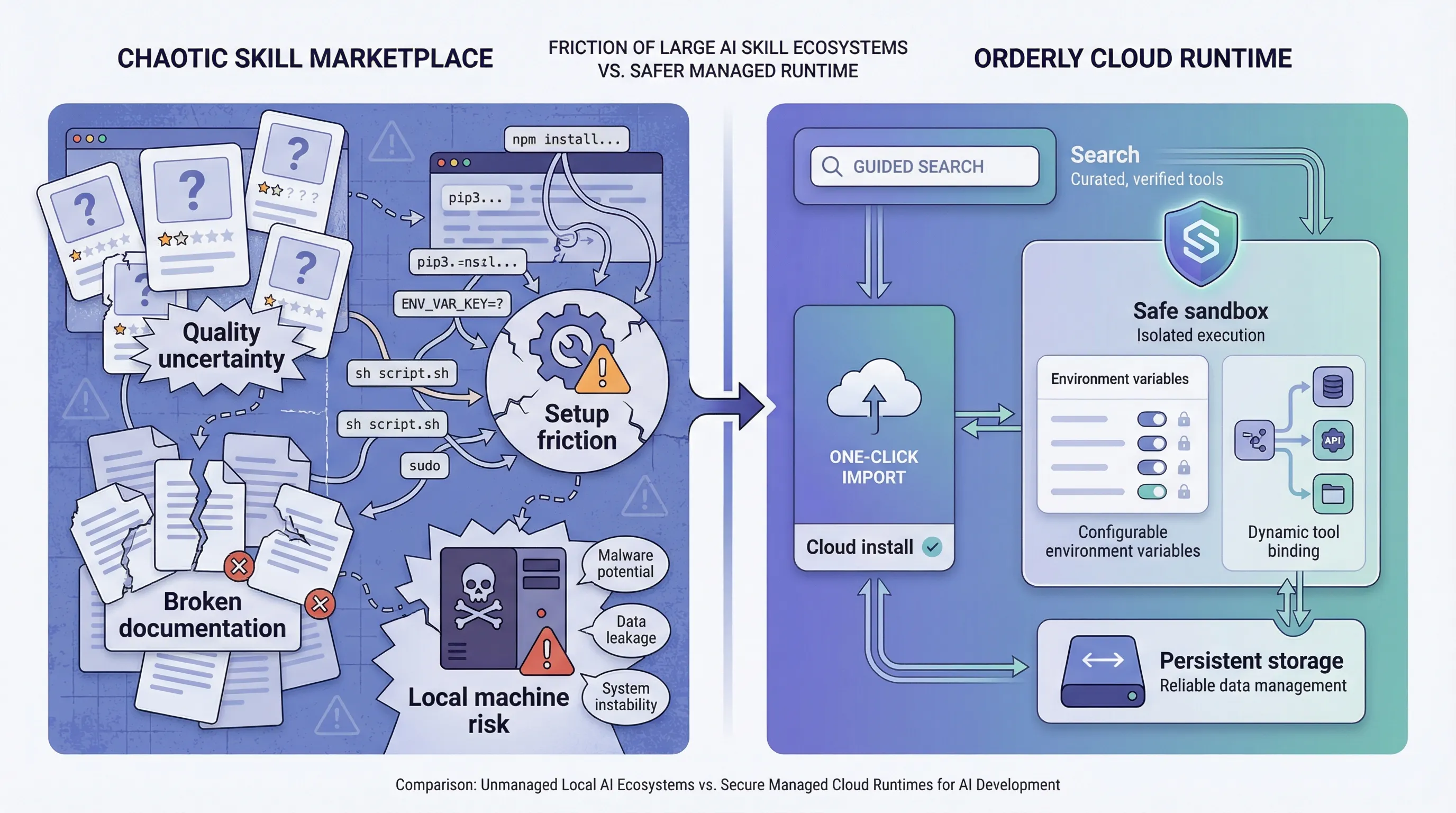
Once an ecosystem grows to tens of thousands of skills, several structural problems appear at the same time.
1. Quality becomes hard to judge
For ordinary users, a large skill marketplace is not automatically empowering. It can be confusing.
A skill may have an attractive description and still be poorly designed. Another may be technically sound but badly documented. Some are narrow but reliable; others are ambitious but brittle. Without a clear environment for discovery, inspection, and testing, users are left to make judgments with limited information.
This is not only a usability problem. It is a reliability problem.
If skills are going to become the building blocks of agent workflows, users need a way to evaluate them with lower cognitive cost.
2. The cost of trying is still too high
A healthy ecosystem depends on experimentation. But in practice, trying a skill often comes with too much friction.
You may need to find the right repository, install dependencies, configure environment variables, connect tools, and hope the documentation is current. For a technical user, this is inconvenient. For a non-technical user, it is often enough to stop the process entirely.
That means many potentially useful skills remain unused, not because they lack value, but because the path to first use is too costly.
3. Local installation introduces real security risk
There is also a more serious concern: local execution.
Installing unfamiliar skills on a local machine means accepting risk that many users cannot properly assess. A skill may require package installation, shell execution, API credentials, file access, or MCP connections. Even when the author is acting in good faith, the operational surface is large.
The issue is not paranoia. It is structure.
As the ecosystem grows, users should not have to choose between experimentation and basic safety. A mature skill ecosystem needs a mature runtime environment.
ConsoleX’s answer: full support for Agent Skills, with a proper runtime
This is the context in which we rebuilt ConsoleX AI.
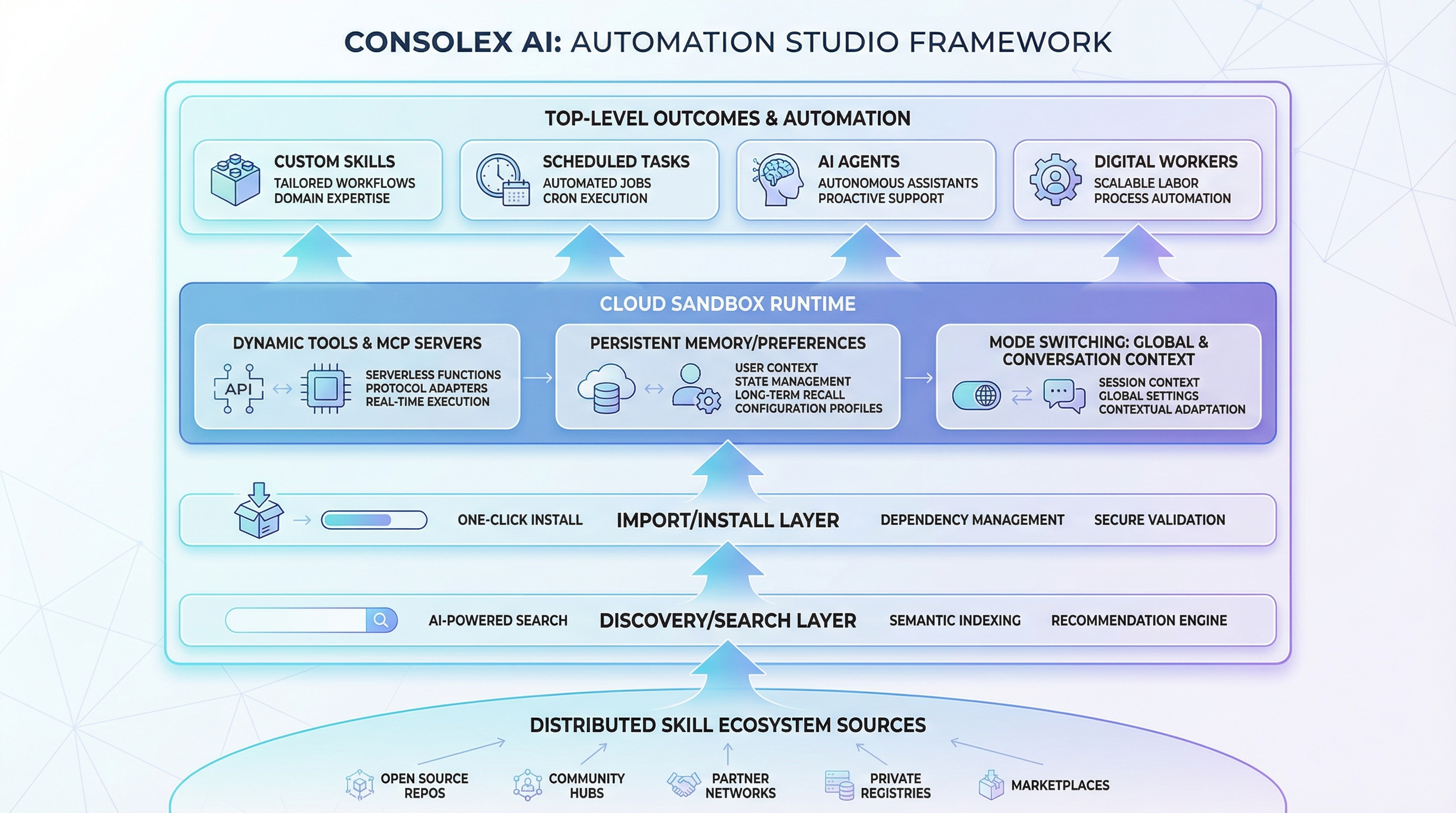
Our view is simple: supporting skills is not enough. What matters is the full chain around them — discovery, installation, execution, safety, persistence, and customization. If any part of that chain remains fragile, the user experience remains incomplete.
So ConsoleX AI is being rebuilt as a more complete environment for the Agent Skills era.
Search and discover skills across the ecosystem
The first problem is finding the right skill in the first place.
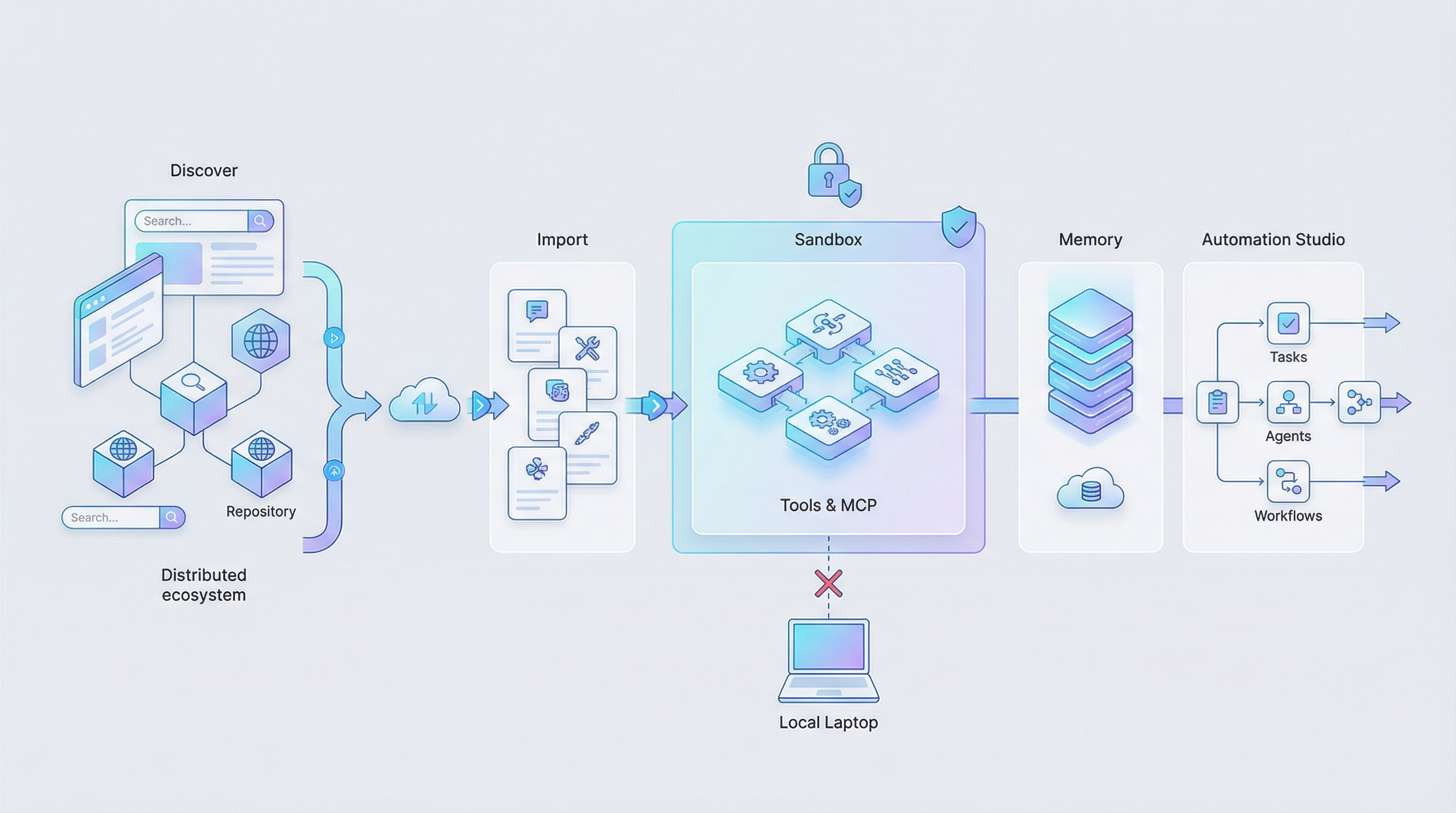
ConsoleX supports skill search and discovery across major external ecosystems, including Agents.sh and Clawdhub. This matters because the ecosystem is already distributed. Useful skills do not live in one curated shelf. They are scattered across communities, registries, and repositories.
Search, in this context, is not a cosmetic feature. It is a navigation layer for complexity.
If the skill ecosystem continues to grow, users need a practical way to move through it without drowning in noise.
Import and install skills from the cloud
Discovery alone is not enough. A user should be able to move from finding a skill to actually using it without unnecessary operational burden.
ConsoleX supports cloud-based import and installation of skills from Agents.sh, Clawdhub, and GitHub skill repositories. This reduces the gap between “interesting” and “usable.”
The value here is not merely convenience. It is lowering the threshold of experimentation.
When trying a skill becomes easier, users are more willing to explore. When exploration becomes easier, the ecosystem becomes more alive. That is how a tool layer turns into real infrastructure.
Run skills in a cloud sandbox, not on your local machine
This is one of the most important changes.
ConsoleX can run skills in a cloud sandbox, so users do not need to install them locally. In practical terms, this means users can test and operate skills while staying farther away from the security risks of local execution.
The sandbox also supports environment variable configuration, which is essential for many real-world skills. A skill often needs API keys, service endpoints, or runtime settings. These should be configurable, but they should not force users into fragile local setups.
This changes the cost structure of experimentation.
Instead of asking users to trust first and evaluate later, ConsoleX makes it easier to evaluate within a more controlled environment. That is a healthier default.
Dynamically load tools and MCP servers with skills
Skills are not useful in isolation. In many cases, they need to connect to tools and MCP servers in order to do real work.
ConsoleX allows skills to bind tools and MCP servers, and to load them dynamically when the skill itself is loaded. This is important for two reasons.
First, it reduces configuration burden. The user does not have to manually reconstruct the skill’s operating environment each time.
Second, it makes the execution model more coherent. A skill is not just a block of text instructions. It is a unit of capability, and capability often requires attached runtime components.
If we take agent systems seriously, then loading a skill should mean loading the right context for that skill to function.
A local virtual directory for persistent preferences
Useful automation is rarely stateless.
A serious workflow needs memory: templates, settings, prior outputs, reference files, and personal preferences. Without persistence, every conversation starts from zero. That is inefficient, and it pushes users back toward repetitive setup work.
ConsoleX provides a local virtual directory for persistent personalized storage. This gives skills and conversations a stable place to retain useful state over time.
This may sound like a small feature, but it changes how users work. Once preferences and context can persist safely, automation becomes less performative and more practical.
Switch between global mode and conversation mode

Not every skill belongs everywhere.
Some behaviors should apply broadly across a user’s environment. Others are specific to a single task, a single project, or a single thread of work. Treating all context as global creates clutter. Treating everything as temporary creates repetition.
ConsoleX supports switching between global mode and current-conversation mode. This gives users a more precise way to control how skills and context are applied.
In other words, it respects a basic reality of knowledge work: some tools are habits, and some are situational instruments.
A good system should know the difference.
Create and add skills through conversation
A mature skill platform should not only help users consume skills. It should also help them create and adapt them.
ConsoleX allows users to create and add skills directly through conversation. This matters because many useful workflows begin as one-off requests. A user solves a problem once, then realizes the pattern is reusable. The natural next step is to turn that pattern into a skill.

That conversion — from ad hoc conversation to reusable capability — is where much of the long-term value of AI automation lives.
If creating a skill requires too much ceremony, most users will never do it. If it can happen naturally inside the same working environment, customization becomes far more realistic.
ConsoleX AI as an automation studio
All of this points to a broader direction.
We do not see ConsoleX AI as only a chat interface, or only a skill host, or only an agent runner. The ambition is larger and more concrete: to make it the best AI automation studio for real work.
That includes several layers of use:
- discover skills
- try skills
- import and install skills
- create and customize skills
- call skills directly in conversation
- convert one-off conversations into scheduled tasks
- build AI agents
- let digital workers take over repetitive operational work
This is especially important for the operator of a one-person company, or a very small team.
In that setting, the problem is rarely lack of ideas. More often, it is lack of bandwidth. Administrative repetition, fragmented workflows, and operational overhead consume attention that should be spent on judgment, product, and creativity.
Skills, when supported properly, can help close that gap.
But only if the surrounding system is reliable enough.
Beyond novelty
The broader AI market still spends too much time on appearances: larger claims, louder language, thinner practical value. We have seen this pattern before. New technology generates excitement, then ecosystems form, then users discover that what matters is not spectacle but structure.
The same is now happening with agent skills.
The future of this ecosystem will not be decided only by how many skills exist. It will depend on whether users can find the right ones, judge them with reasonable confidence, run them safely, adapt them to their own workflows, and build on top of them without unnecessary friction.
That is the standard we care about.
ConsoleX AI is being rebuilt around that reality.
Not because every part of the ecosystem is already mature, and not because every problem is solved, but because the direction is now clear: if AI is to become a serious layer of personal and business automation, it needs better operating conditions.
The goal is not to automate for the sake of automation. It is to remove the tedious, repetitive, and low-leverage parts of work so that people can recover time for the parts that actually require thought, taste, and responsibility.
That is still a demanding goal. It deserves tools built with some restraint.
And that is what the reborn ConsoleX AI is trying to become.
